Blog · Hospitals · 5 min read
Hospital customer service: stop losing enquiries between departments
Why patient enquiries vanish between hospital departments, and six steps to give every one a front door, an owner and a callback.
By the Kren Agency team ·
Hospital customer service breaks down most often between departments. A patient calls about an antenatal booking, gets transferred to a line that rings out, and books somewhere else. The fix is simple to describe: one front door for every enquiry, written routing rules, one named owner per enquiry, callbacks with a time attached, and a weekly count of what was lost.
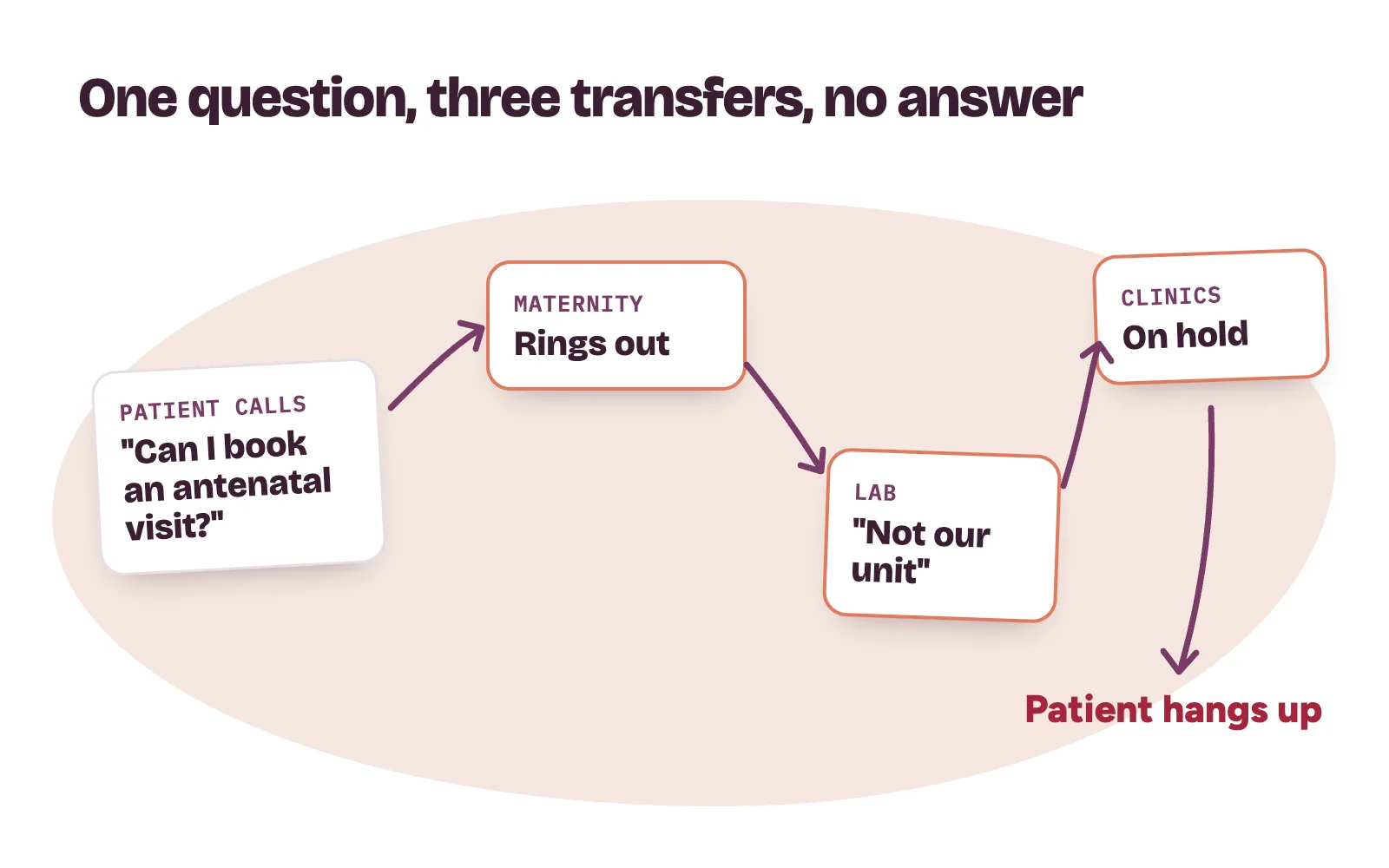
Where do hospital enquiries get lost?
A clinic has one desk. A hospital has many doors: the main line, the maternity ward, the lab, the specialist clinics, pharmacy, social media inboxes and the reception counter. Each one takes questions, and few of them talk to each other.
These are the leaks we see most often:
- Transfers that ring out. Reception passes the call to a department extension. Nobody answers, and the caller hangs up.
- Department phones nobody watches. A ward or lab number sits on a desk or in a staff member's pocket, and messages wait for days.
- "Someone will call you back." Said kindly, written nowhere, owned by no one.
- Social media messages. They land with whoever runs the page, who cannot answer a question about a scan or a surgery consultation.
- Walk-in questions. A visitor asks about a health check at the counter. Nobody takes a name or number.
Each leak is small on its own. Together they decide how many bookings your departments get. Our post on private hospital marketing in Nigeria shows how every department brings in its own enquiries. This post is about catching them.
How to fix hospital customer service in six steps
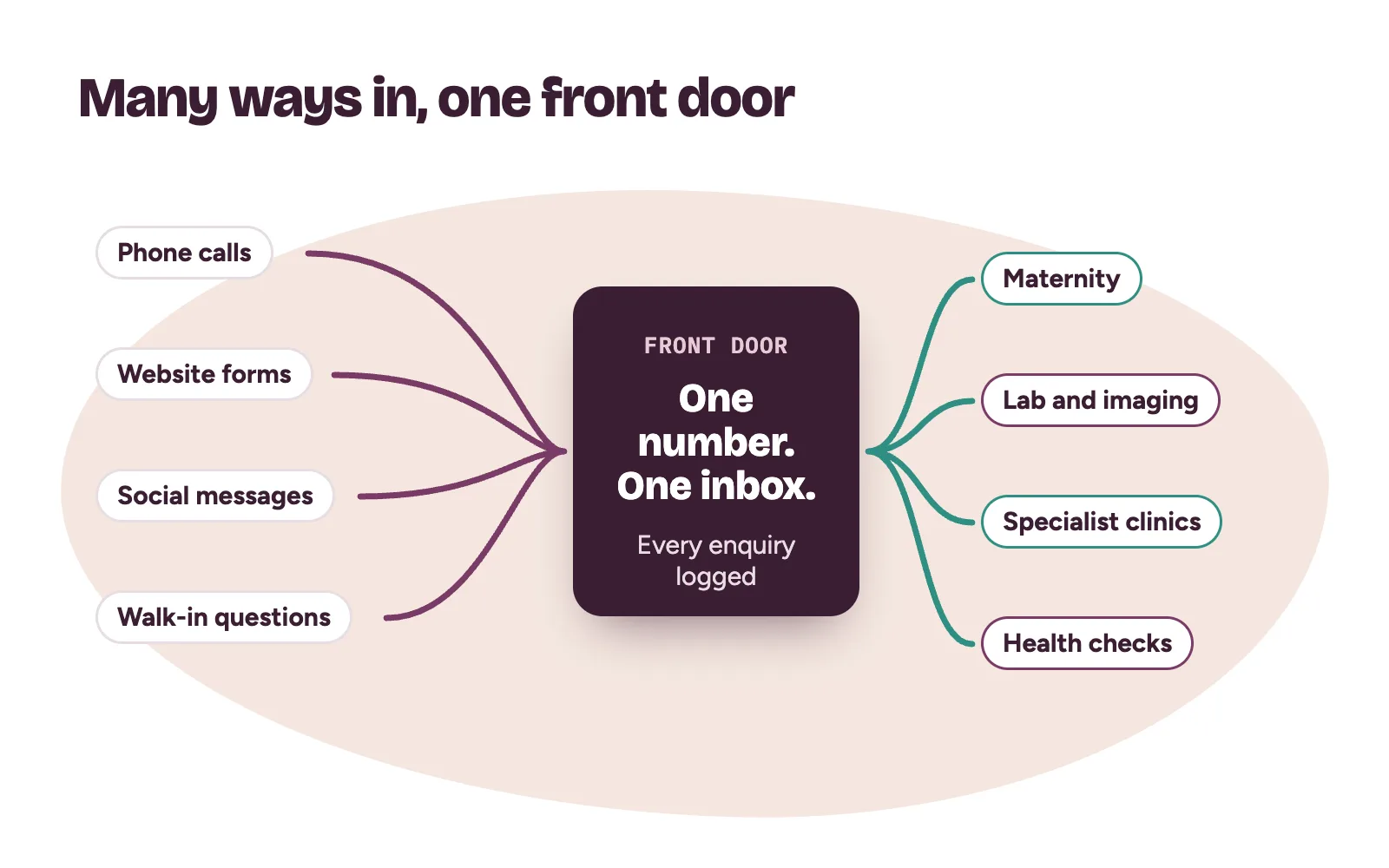
1. Give patients one front door
Pick one main phone number and one message inbox for all new enquiries. Put them on your website, your Google listing and every advert. Keep them on hospital-owned phones, never staff personal lines.
Departments can keep their own lines for existing patients. New enquiries come through the front door, so nothing starts in a place nobody checks.
2. Write the routing rules on one page
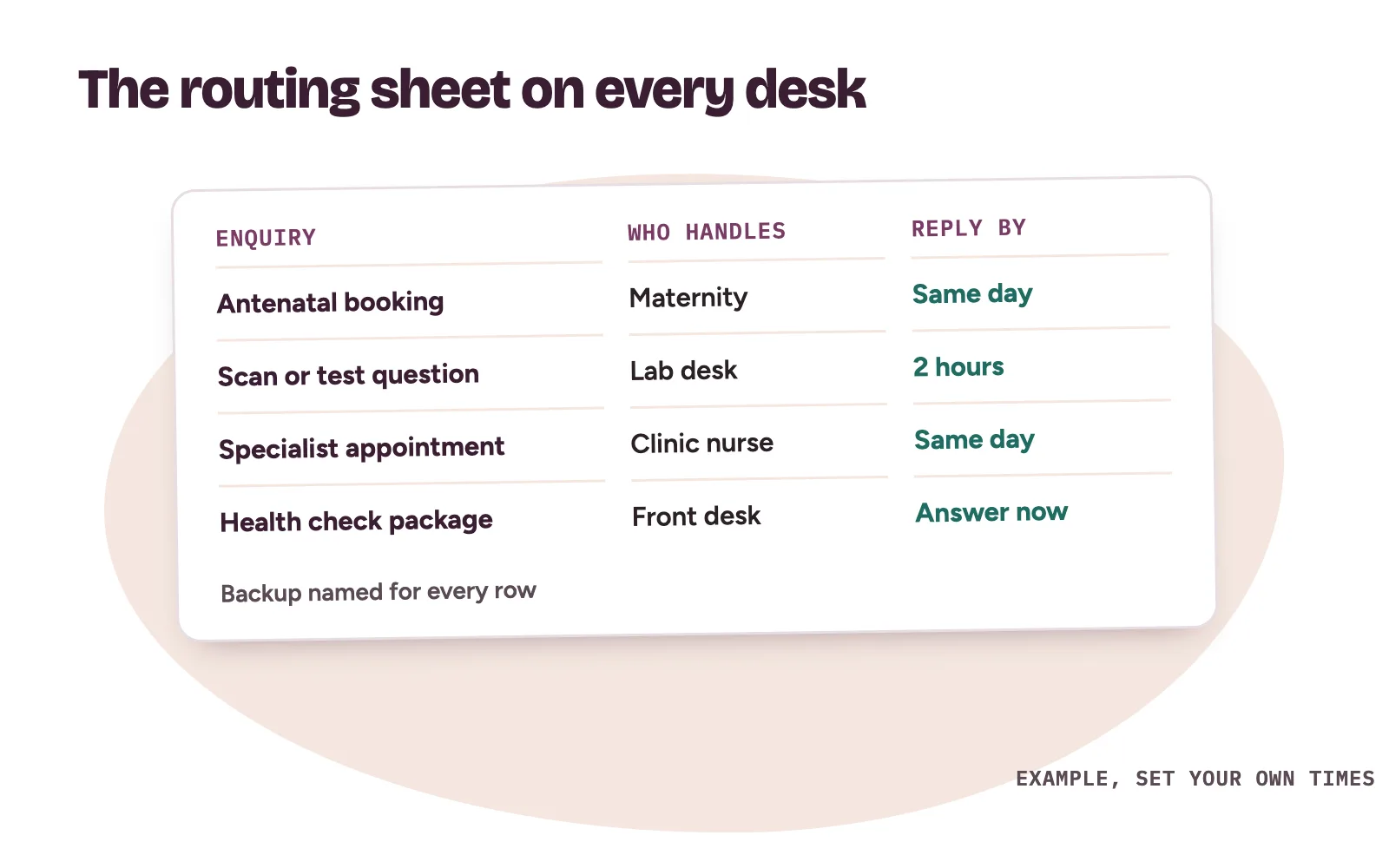
Your front desk should never have to guess where an enquiry goes. Write a one-page sheet with four columns: type of enquiry, department, the person who handles it, and how fast they reply.
Include the questions the desk can answer itself, like opening hours, location and what to bring. Everything else goes to a named person, with a backup for when that person is off duty.
3. Give every enquiry one owner
The person who receives an enquiry owns it until a department confirms it has taken over. A transfer only counts when someone on the other side says "I have it". If the line rings out, the enquiry stays with the front desk.
This one rule stops most of the bouncing. Patients stop hearing "that is not our unit" from three people in a row.
4. Promise callbacks with a time
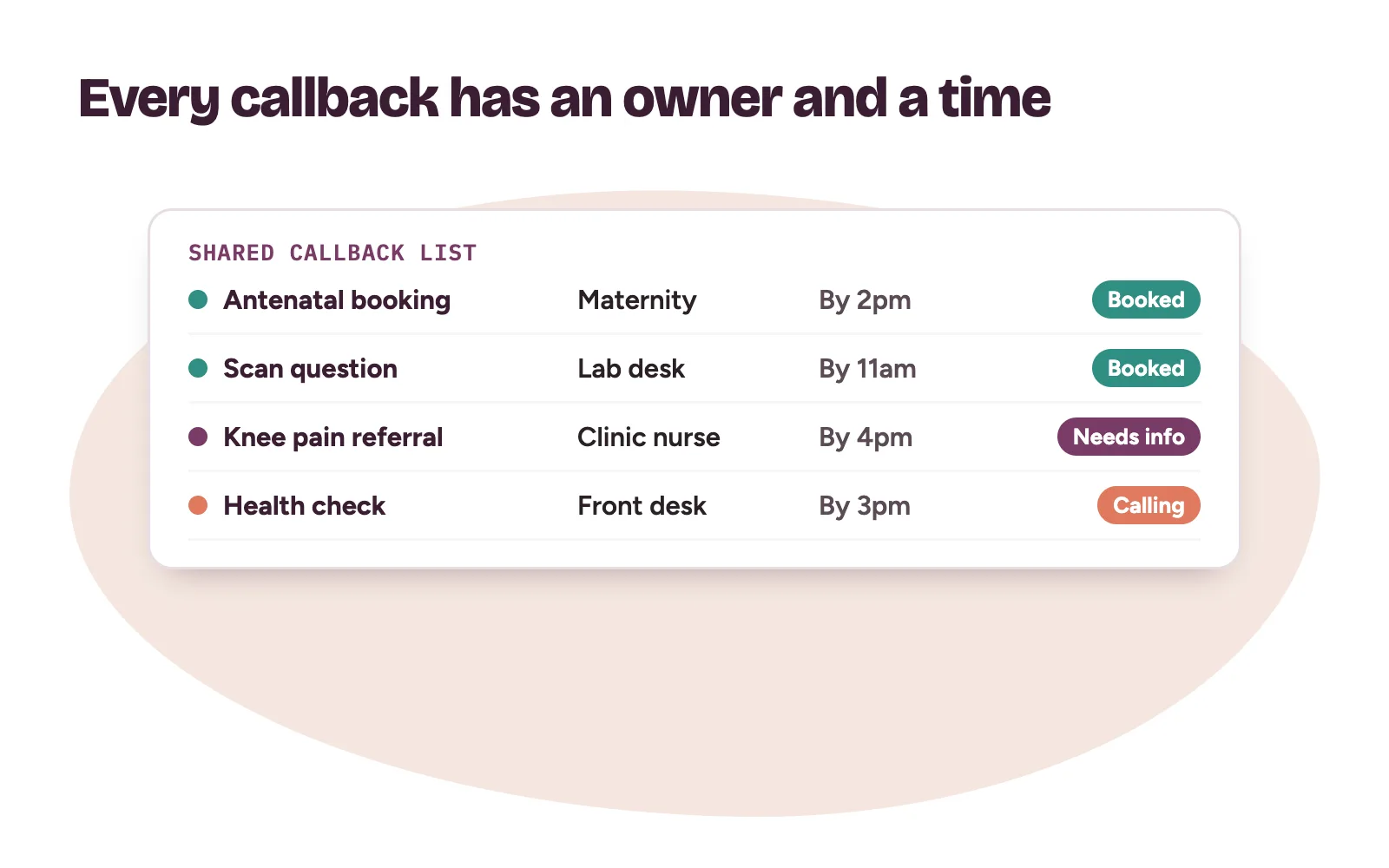
When a department cannot take a call, the desk logs the patient's name, number, question and the time promised. Keep it in one shared list, not on paper scraps.
The department owner calls back within the promised time and marks the outcome: booked, needs more information, or not interested. Set a time your team can keep every day. Our post on front desk missed calls covers how to run that callback list.
5. Count what you lose every week
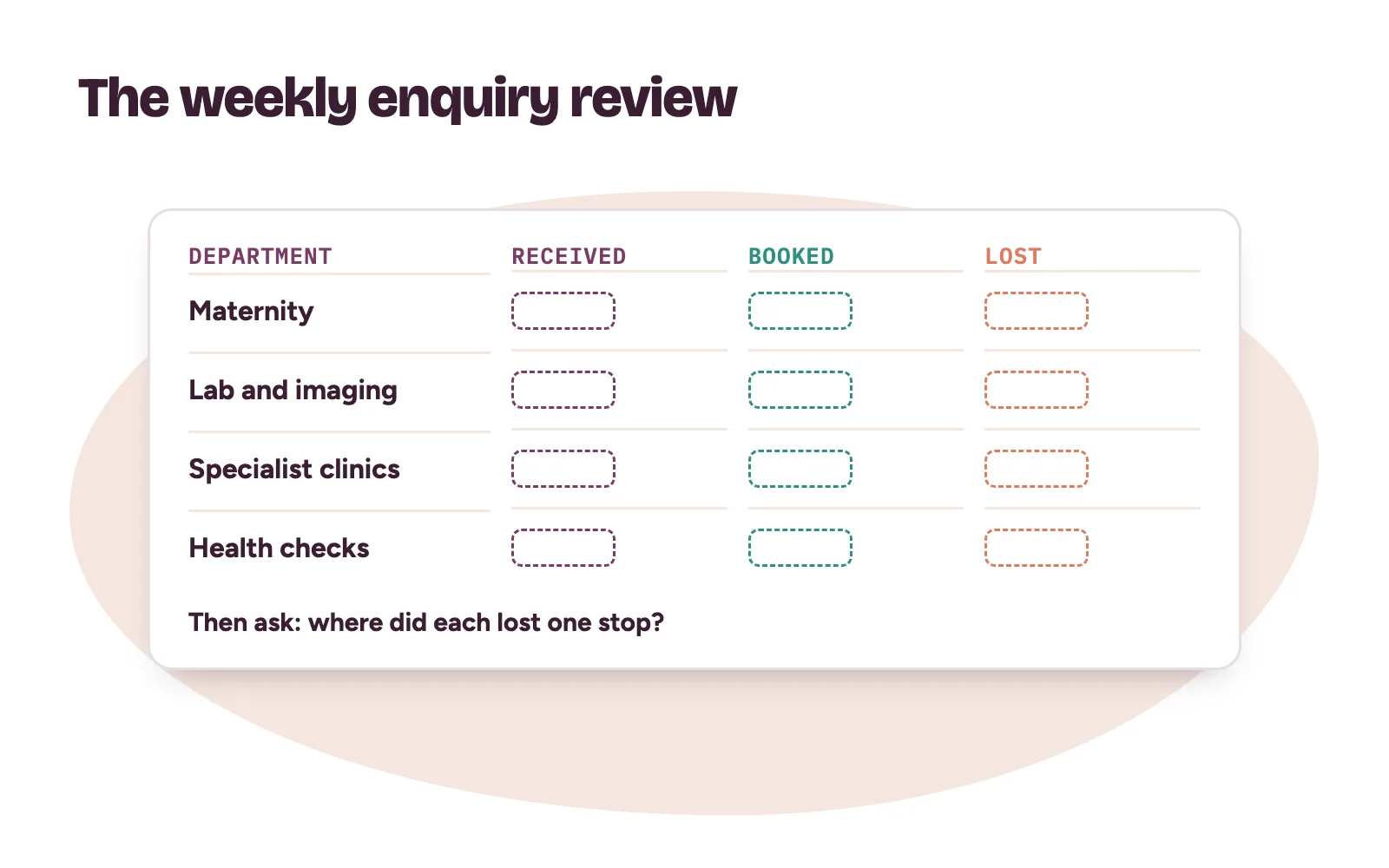
Once a week, pull three numbers per department: enquiries received, enquiries booked, and enquiries lost or never answered. Then ask where each lost one stopped.
Patterns show up fast. One unit misses calls at shift change. Another never answers messages after 4pm. You fix the cause, and the leak closes.
6. Train the desk and the departments together
Front desk staff and department staff need the same playbook. Practise warm transfers: introduce the caller, their question and their name before handing over. Practise the callback promise too.
Make sure patients see the right hours before they call. On your Google Business Profile, you can set main hours, special hours for holidays, and "more hours" when different services keep different times (Google Business Profile Help: edit your business hours). Our post on front desk customer service covers greetings, price questions and complaints.
Where Kren fits
Kren is a growth partner for private hospitals in Lagos and Abuja. We find where your enquiries leak, set up the front door, the routing and the callback tracking, and build the automations that acknowledge every enquiry quickly. Your own team does the final follow-up and books the patient.
Our leak closure work starts with exactly this: tracing each enquiry from first contact to booking, and fixing every point where it stops.
Questions hospital leaders ask about customer service
Should each department keep its own phone number?
Departments can keep their lines for existing patients. New enquiries work better through one main number and one inbox. That way every new enquiry is logged before it is routed.
Who should own an enquiry that is transferred?
The person who first receives it, until someone in the department confirms they have taken it over. If nobody picks up, it stays with the front desk and goes on the callback list.
How fast should departments call back?
Set a callback time your team can keep every working day, and tell the patient that time. A promise kept builds trust. A missed one sends the patient to another hospital.
Can our Google listing show different hours for different services?
Yes. Google Business Profile lets you add "more hours" when different services you offer keep different times, alongside your main and holiday hours.